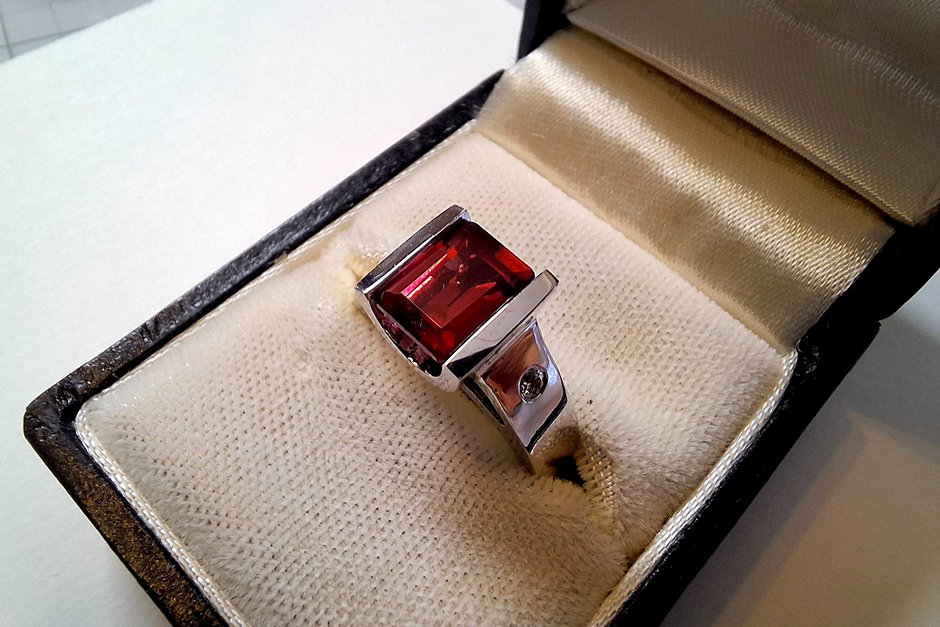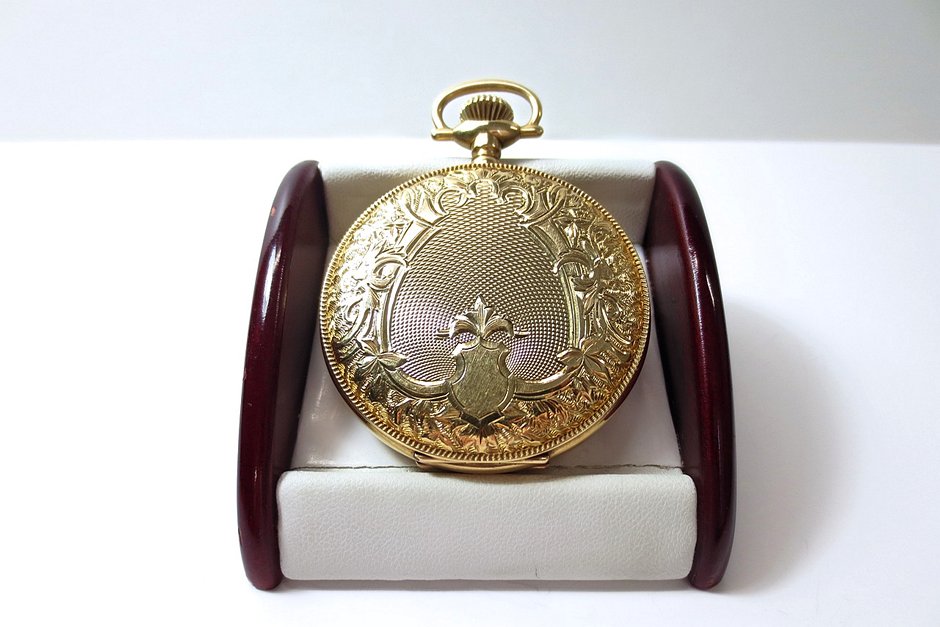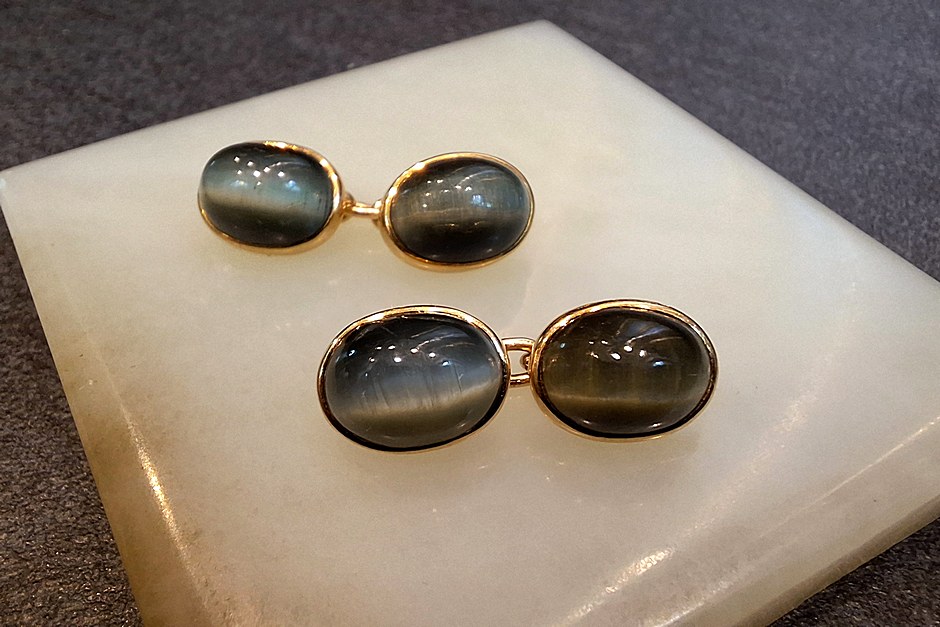
Vintage jewelry price trends have been higher during 2026. And this pair of 1950s Mid-Century 14 karat gold and hawk’s eye cufflinks is a prime example of the type of jewelry that has been rapidly increasing in value.
The last couple years have been a tough time for lovers of vintage and antique jewelry. Prices for fine pieces have exploded higher. This unfortunate development has been driven by two intertwined crises. The first is the skyrocketing price of gold, which topped-out well past $5,000 an ounce in early 2026. The second is the lingering reverberations of the COVID inflation, which although less obvious than rising precious metal prices, has proven to be much more widespread and pernicious.
So antique and vintage jewelry price trends for 2026 (and 2025 for that matter) have been undeniably higher. And sure, if you just inherited grandma’s massive collection of Art Nouveau gold and enamel brooches, this might seem like a great thing. But if you are interested in buying – either as a longtime collector or a relative newcomer to the aesthetic candy land that is antique jewelry – the price increases have been nothing short of disastrous.
Over the last year, the gold price skyrocketed past $3,000 an ounce, $4,000 an ounce and $5,000 an ounce, before finally settling in the $4,000 range. This frenetic price action has rendered most vintage fine jewelry unaffordable to all but the wealthiest of connoisseurs.
Here is the basic problem.
As the gold price rises, pieces that formerly sold for $500 now sell for $1,000. Pieces that sold for $1,000 now sell for $2,000. Pieces that sold for $2,000 now sell for $4,000, and so on. Examples that used to trade primarily based on their history and craftsmanship must now factor in the elevated value of their metal content.
Platinum doesn’t offer a safe harbor either. Prices for that precious metal, although still cheaper than gold, have still risen more or less in lockstep with its yellow cousin. In addition, antique platinum jewelry is relatively uncommon when compared to the ubiquity of old gold jewelry. This rarity means platinum pieces are usually only offered at premium prices.
So as old jewelry prices continue ever upward, what recourse does the aficionado of high quality antique jewelry have?
While there is hope, first I want to tell you the bad news.
The under $500 market for fine vintage jewelry is dead!
I talked about this emerging vintage jewelry price trend over three years ago in an article I wrote called “Antique Jewelry Trends – Inflation in 2023 and Beyond“. Unfortunately, my gloomy prognostication from that time has finally come true.
It is currently almost impossible to buy high quality 14 karat solid gold (or better) or solid platinum antique pieces for less than about five C-notes. I know because I’ve spent the past 12 months furiously vacuuming up the last fine vintage jewelry I could find in that price range.
Sometimes I bought because a piece had impeccable zeitgeist or styling. Other times I bought because a piece was set with luscious and valuable gemstones, like tourmaline or fancy garnets. And yet other times I bought because a piece was selling for less than the melt value of its gold.
The one common element throughout my buying spree is that I rarely paid more than $500 for a piece. But after diligently scouring the market for so long, it hardly seems worthwhile to even search much below this price point anymore. The market has had a full year to adjust to the new, higher reality of vintage jewelry price trends. The inexpensive material has largely either been purchased already, or had its price increased by the seller.
Oh sure, you may be able to technically sneak in just below the new $500 price floor if you are lucky or patient. There will still be the occasional bargain listed for $475 or $499. But even then most of these barely sub $500 pieces will belong to smaller, lighter-weight antique jewelry categories like stickpins or wedding bands.
The calculations behind old fine jewelry pricing are both uncompromising and unapologetic.
As I write this, the melt value of solid 14 karat gold is around $80 a gram. Solid 18 karat gold is $103 per gram. And it is a general rule of thumb in the antique and vintage jewelry market that high quality pieces are well priced at double their intrinsic value. This means that newly listed fine vintage jewelry will generally not be offered much below around $150 or $160 a gram.
What does $500 get you in this context? Not much!
If we divide $500 (our theoretical baseline budget) by $150 (the price of 14 karat gold per gram) we come up with just over 3 grams. That is how much antique or vintage gold jewelry, by weight, that $500 will buy you right now.
That is not very much weight.
And due to solid karat gold’s extremely high density, those 3 grams of gold will appear even smaller in real life. As I alluded to before, a $500 budget these days will only get you the very smallest, least impressive pieces of old gold jewelry – items like stickpins, bracelet charms, tiny pendants or dainty rings.
And all this assumes you are not trying to purchase vintage jewelry set with valuable colored gemstones, which are often more expensive on a per weight basis than karat gold. If you are trying to buy antique pieces set with natural (non-synthetic) rubies, sapphires or emeralds – average prices are considerably higher than $150 a gram. I’ve noticed this particular jewelry price trend hitting Edwardian and Art Deco pieces especially hard.

Photo Credit: Elegant Cufflink
This lovely Edwardian Jade and 14 karat gold stickpin, circa 1910, is a great example of antique jewelry that has broken above the magical $500 price point. As recently as early 2025, this piece would have been in the $300 to $400 range, but is now listed for $545.
But all is not yet lost!
I have 6 bits of useful advice for those looking to navigate today’s rising vintage jewelry price trends.
1) Look for Stale Pricing
Stale pricing refers to a situation where a seller has listed his inventory before a major upward market adjustment. As a result, the seller’s inventory remains below the market price until he either sells out of his inventory or re-prices it upward. Stale pricing has traditionally been most common in developed markets with stable currencies (think the U.S., Western Europe, Japan, etc.) because bouts of extreme inflation have historically been uncommon in these places.
Of course, many vintage jewelry sellers absolutely will re-price their wares to stay in line with the market. And sales from any existing stale-priced inventory absolutely will accelerate simultaneously. Therefore, stale pricing is a transitory phenomenon that naturally disappears after two or three years.
Unfortunately, we are near the tail-end of the stale pricing paradox. So while I would still encourage you to be on the lookout for it, you’re chances aren’t good.
2) Seek out Fashion Refugees
Fashion refugee is a term I coined for types of antique and vintage jewelry that aren’t used anymore. Here is a quick (but not exhaustive) list: brooches, hair pins, hair combs, hat pins, stickpins, tiaras, cufflinks, studs and tie pins. The fact that they are no longer commonly used as jewelry means that demand is lower in the secondary market. This makes fashion refugees cheaper on a per gram basis – all else being equal – than similar antique jewelry in more popular categories such as rings, bracelets, necklaces or earrings.
You may still see fashion refugees occasionally worn as jewelry today, but it is rather rare. And although my list of anachronistic jewelry categories seems rather long, it doesn’t mean they are all equally forgotten. For example, I feel strongly that brooches are bound to comeback into fashion at some point. But I am also equally certain that tiaras are well and truly dead from a fashion perspective.
In any case, as jewelry price trends continue upward, fashion refugees can offer tremendous bang for your buck – provided you are interested in the types of jewelry on offer!
Vintage 1980s Fine Jewelry ($250 to $1,000) for Sale on eBay
(This is an affiliate link for which I may be compensated)
3) Pursue Millennium Era 1980s and 1990s Vintage Jewelry
Approximately half of the pieces I’ve purchased during my latest jewelry buying binge have been from the 1980s and 1990s. This is no accident. This time period – known as the Millennium era – combined bold geometric motifs, vibrant colors and expensive materials to produce some truly stunning works of art. In fact, jewelry from this era is so compelling that I consider it to be the spiritual successor to Art Deco jewelry from the 1920s!
Despite this list of positive attributes, vintage jewelry from the Millennium era is still inexplicably undervalued in today’s market. I attribute this mispricing primarily to the fact that 1980s and 1990s jewelry is still regularly coming out of estate sales in abundance. However, in spite of the volume of Millennium era jewelry on the market currently, really high quality pieces are still surprisingly scarce.
Another reason why I suspect that Millennium era jewelry isn’t getting its time in the sun yet is because it’s so recent. A lot of collectors haven’t quite caught up to the fact that 1980s and 1990s jewelry is the latest member of the vintage jewelry club, being a full 25 to 50 years old. It seems somehow too familiar – and perhaps for good reason. After all, this is the same jewelry many of our mothers or grandmothers wore not so long ago.
Regardless of why it is undervalued, the fact remains that Millennium era jewelry offers one of the most compelling values in the entire vintage jewelry market at the moment. And if that isn’t enough to convince you of the value of 1980s and 1990s jewelry, then I will simply add that I have purchased marvelous examples of fine jewelry from this era for less than $100 within the past year.
Buying fine vintage jewelry for under $100? Now that’s a bargain!
And if you’re interested in learning more on the topic, I’ve written a dedicated article titled “1980s & 1990s Vintage Jewelry – Millennium Chic“.

Photo Credit: Narmada Jewelry
This handmade 1970s Brutalist sterling silver and 14 karat gold brooch showcases the kind of fine jewelry that is still available for a surprisingly low cost – less than $200 in this case.
4) Consider Silver or Mixed-Metal Vintage Jewelry Instead of Gold
If the brutal mathematics of solid gold and platinum jewelry has rendered them too expensive, then sterling silver or mixed-metal silver and gold pieces may offer a unique opportunity to the vintage jewelry connoisseur. The time period from the 1960s to the 2000s encompasses a variety of appealing jewelry styles – Modernist, Brutalist, Mid-Century and Millennium – that often eschewed tradition by relying on silver (instead of gold) as a primary material.
These pieces were frequently hand-crafted by dedicated artisans with considerable care and attention to detail. And it also wasn’t uncommon for silver jewelry of this era to be enhanced with small, solid karat gold elements to create a richer, more interesting visual effect. Gold beads, rims, plaques and bezels could all be added to enhance a larger silver piece. This means that silver jewelry from the latter half of the 20th century can, depending on the level of craftsmanship, sometimes legitimately be considered high-end.
Due to the fact that silver is so much less expensive than gold right now – about $2 a grams for sterling silver versus $80 a gram for 14 karat gold – some truly impressive vintage silver pieces can be purchased for shockingly low prices. Of course, some discretion is necessary here because silver is more common in lower-end jewelry, as opposed to real, high-end fine jewelry. But if you are willing to put in the time and effort, silver and mixed-metal pieces are a great way to escape ever rising jewelry price trends!
5) Search for Unmarked Old Gold Jewelry
Anyone who has been in the antique jewelry game for any length of time knows how important hallmarks are. A hallmark is the purity stamp that you will find on most jewelry attesting to its precious metal content. For example, 14K (58.3% fine) and 18K (75% fine) are two common gold hallmarks.
However, not all antique jewelry is hallmarked! A surprising amount of old gold jewelry doesn’t have any markings at all – neither a maker’s mark nor a fineness hallmark. These pieces can not only still be made out of solid karat gold, but can also be exceptionally well made.
Your advantage with unmarked vintage jewelry is that it can sometimes be found at a modest discount compared to hallmarked pieces. Of course, you will not get something for nothing – gold is gold after all! But you may be able to snag a great piece of solid 14 karat gold jewelry for $120 to $140 a gram versus $150 or $160 a gram at “full vintage price”.
Of course, the downside is that you have to trust the seller of an unmarked piece. Antique gold-filled jewelry, in particular, can sport a patina that looks stunningly close to solid karat gold. Happily, reputable sellers will test unmarked jewelry via acid test, electronic gold tester or X-ray fluorescence (XRF) and guarantee the results.
Vermeil & Sterling Vintage Costume Jewelry Under $100 for Sale on eBay
(This is an affiliate link for which I may be compensated)
6) Explore High-End Vintage Costume Jewelry
To be honest, I am a bit conflicted about this final recommendation. Almost every vintage piece I buy for myself is what I consider to be high-end fine jewelry. I define this as jewelry made of solid 14 karat gold or better, solid platinum or solid silver – often set with real precious stones. In contrast, I have traditionally viewed the costume vintage jewelry market as being not only generally overpriced, but also far too name brand obsessed.
However, in light of persistently rising jewelry price trends, I have recently softened my stance on costume vintage pieces after much research and reflection. It is possible to routinely find examples from the golden age of costume jewelry (from the 1930s to the 1960s) crafted in sterling silver or vermeil (gold plating over sterling silver) for less than $100 – particularly if you are willing to buy unbranded pieces.
As an added bonus, it is common for vintage costume jewelry of this period to exhibit excellent stylistic zeitgeist, which is one of the primary reasons why we all love vintage jewelry so much in the first place! You can even sometimes pick up entire vintage costume jewelry suites consisting of some combination of a necklace, bracelet, brooch, ring and earrings for less than $200.
Now for the caveats.
Please don’t buy vintage costume jewelry with the expectation that it will appreciate in the future. Unlike most high-end fine jewelry, costume pieces do not contain real gold or gemstones and therefore will not increase in value the same way. Yes, a high quality vintage costume piece may appreciate in value anyway. But you certainly can’t count on it.
I also feel strongly that you must stick exclusively to high-end costume jewelry that is in excellent condition! It is imperative that you meticulously check any piece you are interested in buying to ensure it isn’t damaged or missing any rhinestones. This is, incidentally, why I advocate for purchasing sterling silver or vermeil costume pieces. Examples rendered in silver and vermeil are more resistant to wear and corrosion than pieces made from gold-plated or silver-plated base metal.
As a final warning, be aware that it is very easy to overpay for some well known name brands such as Crown Trifari, Miriam Haskell and Mazer Brothers, among others. In some scenarios, the most expensive vintage costume jewelry can approach – or even surpass – $1,000 per piece! At that point you are well into fine jewelry price territory. Therefore, I personally don’t recommend paying more than $200 to $250 for a piece of vintage costume jewelry, no matter how nice it seems.

Photo Credit: Green Moon House
Featuring an anthropomorphized stork with a cane, bow tie and top hat, this 1940s Retro era vermeil brooch is both playful and sophisticated. Condition is paramount for a piece like this, which is considered costume jewelry. Unfortunately, although it isn’t easily visible in the photo, this brooch is missing a rhinestone on the stork’s bow tie.
The really wonderful thing about the vintage jewelry buying tips I’ve just given you is that they can be mixed and matched to give you an even greater advantage. For example, you could look for a mixed-metal (tip #4) brooch (tip #2) from the 1980s (tip #3). This would instantly hit 3 out of the 6 vintage jewelry buying tips listed above, giving you maximum bang for your buck.
But as always, buy what you like. And happy jewelry hunting.
Read more thought-provoking Antique Sage gems & jewelry articles here.
-or-
Read in-depth Antique Sage investment guides here.